

CGPA to Percentage Calculator — Formula, Table & University Guide
Use the standard formula (CGPA × 9.5) or switch to your university's rule: VTU, Mumbai, Anna, SPPU, GTU, AKTU & more. Get your exact percentage in seconds, no signup needed.
✅ Get fast, accurate results with no sign-up required

Marks can feel confusing when one system uses numbers like 7.6 or 8.2, and another uses percentages. Many colleges, companies, and foreign universities still ask for marks as a percentage, not a CGPA. That gap creates stress at the worst time, during forms and deadlines. This CGPA to percentage calculator gives you a clear answer in a few seconds. You type your CGPA, choose the right grading scale or university rule, and see the exact percentage along with a short explanation: no manual math, no guessing, and no fear of making a mistake on an important form.
We follow trusted formulas that match official patterns used by boards and universities. For example, CBSE uses the well-known 9.5 rule to convert CGPA to percentage for school results. Universities such as Mumbai University and VTU publish their own equations for this conversion. Our goal is to bring these rules together in one place so you can convert your cumulative grade point average with confidence.
This tool is for students in school, college, and engineering; for fresh graduates; and for anyone who needs to show marks as a percentage for admission, jobs, or study-abroad applications.
How to Convert CGPA to Percentage - Formula to convert CTP
You see one simple box for your CGPA. You choose your grading scale or board, such as:
- CBSE 10-point grading.
- Generic 10-point college grading.
- 4-point scale out of 4.
- VTU scheme.
- Mumbai University.
- SPPU or other listed universities.
Each option uses the correct formula or conversion factor, as specified in official documents or widely accepted university rules. For example:
The calculator can show three things at once:
- Your percentage is based on the selected rule
- A short line with the exact formula used
- A note that reminds you to check your university rulebook if you are not sure
You may also add a small line under the result with one real example.
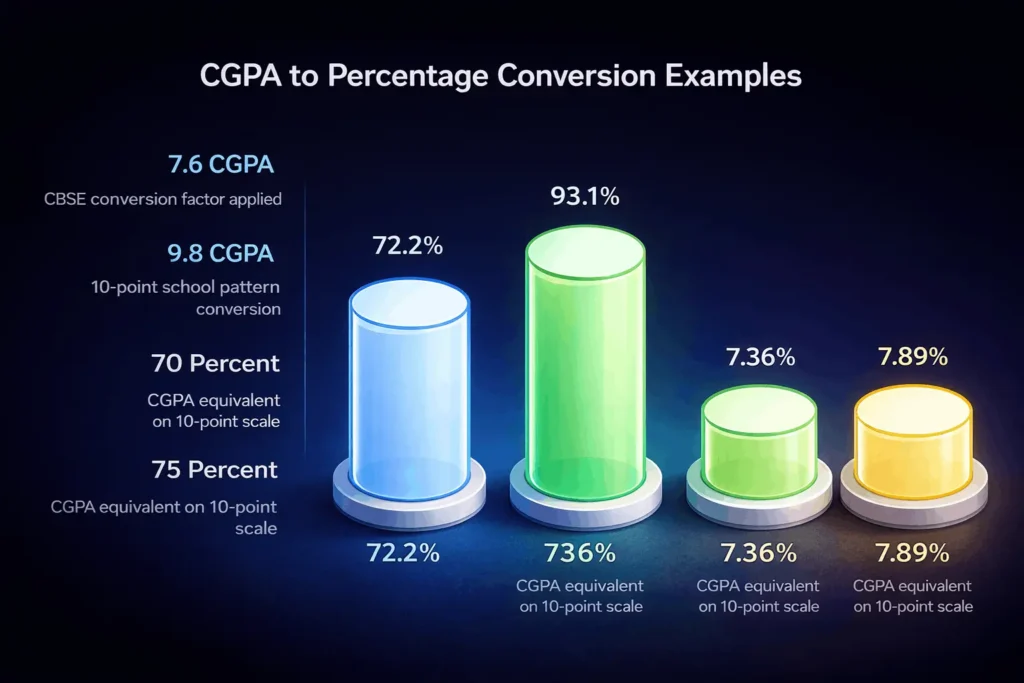
For instance, if a student types 7.6 on a 10-point scale that uses the 9.5 rule, the calculator can show the following:
Many students search for answers like “What percentage is a 7.0 CGPA?” or “What is a 9.8 CGPA in marks?”
The tool answers these questions in a single click while still showing the maths behind it.
You can also let users switch between the following:
What is CGPA? Meaning, Abbreviation, and Importance:
CGPA stands for Cumulative Grade Point Average. It shows how well a student performs across all subjects in a semester or a full programme. Each subject is assigned a grade point, such as 8, 9, or 10, on a common grading scale. Colleges follow different scales. Many use a 10-point scale. Engineering programmes often use credit hours with grade points linked to each credit.
CGPA is not a single test score. It is the average of all grade points earned across a set of exams. Each grade carries a point. Each subject carries a credit. Colleges combine both to get your cumulative grade point average. The exact weight depends on the grading system used by the board or university.
Schools under the CBSE board use a 10-point pattern in many classes and convert grades into grade points. Universities like Makaut, AKTU, VTU, KTU, SPPU, GTU, Anna University, and Mumbai University follow their own rules and publish their tables and formulas in official guides.
CGPA matters in many areas. Colleges check it during admission. Companies check it during hiring. Students also need it when they apply for study abroad programmes. Some portals only accept percentages. Others prefer CGPA. This is why a clear conversion table or calculator becomes important.
A strong CGPA to percentage calculator gives a student more options. It can help with scholarships. It also helps during placement rounds when recruiters set a minimum grade point average. Many universities allow students to improve their performance over time by earning high grades each semester. CGPA tracks this growth.
Now that you know what CGPA means, we can look at the simple process behind the conversion from CGPA to percentage.
How CGPA to Percentage Conversion Actually Works:
Converting CGPA to percentage is a simple process when you know how credit hours, grade points, and total scores come together. The steps below show how most colleges handle this.
Subject Matter Grading
Each subject gives you a grade based on your marks in that course. The grade then maps to a grade point. The mapping follows the grading scale used by the college. For example, many 10-point systems assign 10 points for O, 9 points for A+, 8 points for A, and so on. Some boards use a 4-point scale. A few engineering programmes use a 5-point scale.
Credit Points
Every subject carries a credit. Practical subjects may carry fewer credits. Core subjects may carry more. Colleges multiply the grade point by the credit to measure the weight of that subject in your final average.
Multiplying Grade by Credits
You multiply each grade point by its credit. This results in a score known as credit points or grade points earned. If a subject has 4 credits and you score a grade point of 9, then your total for that subject becomes 36.
Total Calculation
You add all the credit points earned in all subjects. You also add all the credits taken in that semester. You then divide the total credit points by the total credits. This yields your CGPA.
Divide and Conquer:
Here are a few examples that match real searches:
Engineering colleges may follow a different rule. Many use their own conversion table tied to their grading system. Students often ask how to convert CGPA to a percentage for engineering or semester GPA to a percentage for non-engineering. The answer depends on the university scheme. You check the official guide for your college, then apply the formula listed there. We include the common formulas given by VTU, Mumbai University, GTU, SPPU, KTU, MAKAUT, and other boards in the sections ahead.
Why Use Our CGPA Calculator – An Online, Powerful Academic Tool:
Choosing the right CGPA to percentage calculator is important because each college and board uses its own grading scale. A small mistake in the formula can change your percentage in a job form or an admissions portal. This tool removes that risk by using trusted rules based on official documents from major universities and boards.
CBSE released clear grade conversion practices for its 10-point pattern. Mumbai University and VTU also publish conversion methods in their circulars, which include fixed factors and linear equations. We place these rules inside the calculator so students do not need to search across scattered sources.
Below are the features that help this tool stand above common converters.
Accurate Percentage
The formula used for your percentage depends on your grading system. A generic factor does not work for all boards. This tool applies the correct conversion factor for each selected scheme. Numbers stay true to university rules. Students using CBSE, VTU, GTU, SPPU, MAKAUT, KTU, or Mumbai University get results that follow the method listed in their guidebooks.
Precise and Simple Tool
The calculator removes extra steps. You type your CGPA or choose your scale. You press one button. You see the exact percentage along with the formula that created it. This improves trust and keeps the process clean. The layout stays simple, so students from any background can use it without help.
Easy to Use
The tool works for any student, whether in school, engineering, or a regular degree course. You do not need to know the grading system or credit hours behind your CGPA. You choose the right option from the list. The calculator handles the math. This helps during tight deadlines such as exam form submission and online admission.
Detailed Result
Students often want to know how the number came up. The result box shows:
1. Your CGPA
2. Total percentage
3. The exact formula used
4. The grading scale used in the calculation
This helps you explain your marks during counselling, placement interviews, or study abroad evaluations. Some portals ask for the method used to convert marks. This section gives you that clarity.
Copy and Download Result
You can copy your result in one click. Many students paste it into job forms, resume builders, or admission pages. You may also download the result for your personal records. This helps when a college asks for proof of the conversion certificate that produced your percentage.
Performance Report
Some students want more than a single number. This section can show a short report that highlights your current average, your grade range, and a short note on how your marks compare across semesters. It helps you monitor progress and set new goals. This approach works well for engineering students who track performance across credit-based semesters.
This range covers common student searches such as “What percentage is 7.6 CGPA?” and “What is 9.8 CGPA in marks?” These values match the CBSE method shown in academic conversion guides.
Detailed CGPA to Percentage – Table Comparison:
Students often want to see a direct comparison between CGPA and percentage. A table makes this simple. Each grading scale uses a different conversion factor. The tables below follow the common formulas used in Indian boards and universities.
For school results under the CBSE 10-point scale, the board uses the 9.5 rule to convert CGPA to percentage.
Many colleges also use a 10-point system with a similar pattern, though some apply their own factors.
Engineering universities such as VTU and Mumbai University use different equations in their official documents. These rules change how the percentage looks, even if the CGPA stays the same.
Below are simple tables for the 10-point, 5-point, and 4-point scales. These tables use widely accepted factors common in academic practice. Students should still confirm the exact rule listed by their university if the grading system follows a special pattern.
CGPA to Percentage for 10.0 Grade Scale:
This table uses the CBSE rule:
Percentage = CGPA × 9.5
CGPA (10-Grade Scale) | Percentage in 10th Grade Scale |
10.0 CGPA in percentage | 95%-100% |
9.9 CGPA in percentage | 94.05% |
9.8 CGPA in percentage | 93.10% |
9.7 CGPA in percentage | 92.15% |
9.6 CGPA in percentage | 91.20% |
9.5 CGPA in percentage | 90.25% |
9.4 CGPA in percentage | 89.30% |
9.3 CGPA in percentage | 88.35% |
9.2 CGPA in percentage | 87.40% |
9.1 CGPA in percentage | 86.45% |
9.0 CGPA in percentage | 85.50% |
8.9 CGPA in percentage | 84.55% |
8.8 CGPA in percentage | 83.60% |
8.7 CGPA in percentage | 82.65% |
8.6 CGPA in percentage | 81.70% |
8.5 CGPA in percentage | 80.75% |
8.4 CGPA in percentage | 79.80% |
8.3 CGPA in percentage | 78.85% |
8.2 CGPA in percentage | 77.90% |
8.1 CGPA in percentage | 76.95% |
8.0 CGPA in percentage | 76% |
7.9 CGPA in percentage | 75.05% |
7.8 CGPA in percentage | 74.10% |
7.7 CGPA in percentage | 73.15% |
7.6 CGPA in percentage | 72.20% |
7.5 CGPA in percentage | 71.25% |
7.4 CGPA in percentage | 70.30% |
7.3 CGPA in percentage | 69.35% |
7.2 CGPA in percentage | 68.40% |
7.1 CGPA in percentage | 67.45% |
7.0 CGPA in percentage | 66.50% |
6.9 CGPA in percentage | 65.55% |
6.8 CGPA in percentage | 64.60% |
6.7 CGPA in percentage | 63.65% |
6.6 CGPA in percentage | 62.70% |
6.5 CGPA in percentage | 61.75% |
6.4 CGPA in percentage | 60.80% |
6.3 CGPA in percentage | 59.85% |
6.2 CGPA in percentage | 58.90% |
6.1 CGPA in percentage | 57.95% |
6.0 CGPA in percentage | 57% |
5.9 CGPA in percentage | 56.05% |
5.8 CGPA in percentage | 55.10% |
5.7 CGPA in percentage | 54.15% |
5.6 CGPA in percentage | 53.20% |
5.5 CGPA in percentage | 52.25% |
5.4 CGPA in percentage | 51.30% |
5.3 CGPA in percentage | 50.35% |
5.2 CGPA in percentage | 49.40% |
5.1 CGPA in percentage | 48.45% |
5.0 CGPA in percentage | 47.50% |
4.9 CGPA in percentage | 46.55% |
4.8 CGPA in percentage | 45.60% |
4.7 CGPA in percentage | 44.65% |
4.6 CGPA in percentage | 43.70% |
4.5 CGPA in percentage | 42.75% |
4.4 CGPA in percentage | 41.80% |
4.3 CGPA in percentage | 40.85% |
4.2 CGPA in percentage | 39.90% |
4.1 CGPA in percentage | 38.95% |
4.0 CGPA in percentage | 38% |
3.9 CGPA in percentage | 37.05% |
3.8 CGPA in percentage | 36.10% |
3.7 CGPA in percentage | 35.15% |
3.6 CGPA in percentage | 34.20% |
3.5 CGPA in percentage | 33.25% |
3.4 CGPA in percentage | 32.30% |
3.3 CGPA in percentage | 31.35% |
3.2 CGPA in percentage | 30.40% |
3.1 CGPA in percentage | 29.45% |
3.0 CGPA in percentage | 28.50% |
CGPA to Percentage for 5.0 Grade Scale:
Many colleges use a 5-point grading system. A common pattern is:
Percentage = (CGPA / 5) × 100.
This scale is common in credit-based programs that use lower grade bands. Students may also use this pattern when converting marks for international admission forms.
CGPA (5-Grade Scale) | Percentage in 5th Grade Scale |
0.0 CGPA in percentage | 0% |
0.1 CGPA in percentage | 2% |
0.2 CGPA in percentage | 4% |
0.3 CGPA in percentage | 6% |
0.4 CGPA in percentage | 8% |
0.5 CGPA in percentage | 10% |
0.6 CGPA in percentage | 12% |
0.7 CGPA in percentage | 14% |
0.8 CGPA in percentage | 16% |
0.9 CGPA in percentage | 18% |
1.0 CGPA in percentage | 20% |
1.1 CGPA in percentage | 22% |
1.2 CGPA in percentage | 24% |
1.3 CGPA in percentage | 26% |
1.4 CGPA in percentage | 28% |
1.5 CGPA in percentage | 30% |
1.6 CGPA in percentage | 32% |
1.7 CGPA in percentage | 34% |
1.8 CGPA in percentage | 36% |
1.9 CGPA in percentage | 38% |
2.0 CGPA in percentage | 40% |
2.1 CGPA in percentage | 42% |
2.2 CGPA in percentage | 44% |
2.3 CGPA in percentage | 46% |
2.4 CGPA in percentage | 48% |
2.5 CGPA in percentage | 50% |
2.6 CGPA in percentage | 52% |
2.7 CGPA in percentage | 54% |
2.8 CGPA in percentage | 56% |
2.9 CGPA in percentage | 58% |
3.0 CGPA in percentage | 60% |
3.1 CGPA in percentage | 62% |
3.2 CGPA in percentage | 64% |
3.3 CGPA in percentage | 66% |
3.4 CGPA in percentage | 68% |
3.5 CGPA in percentage | 70% |
3.6 CGPA in percentage | 72% |
3.7 CGPA in percentage | 74% |
3.8 CGPA in percentage | 76% |
3.9 CGPA in percentage | 78% |
4.0 CGPA in percentage | 80% |
4.1 CGPA in percentage | 82% |
4.2 CGPA in percentage | 84% |
4.3 CGPA in percentage | 86% |
4.4 CGPA in percentage | 88% |
4.5 CGPA in percentage | 90% |
4.6 CGPA in percentage | 92% |
4.7 CGPA in percentage | 94% |
4.8 CGPA in percentage | 96% |
4.9 CGPA in percentage | 98% |
5.0 CGPA in percentage | 100% |
CGPA to Percentage for 4.0 Grade Scale:
Many foreign universities and some Indian autonomous colleges use a 4-point scale. A common pattern is:
Percentage = (CGPA / 4) × 100.
Many students ask, “My CGPA is 2.90 out of 4. What percentage do I have?”
Based on the common method shown above, it is about 72.5%.
CGPA (4-Grade Scale) | Percentage in 4th Grade Scale |
0.0 CGPA in percentage | 0% |
0.1 CGPA in percentage | 2.5% |
0.2 CGPA in percentage | 5% |
0.3 CGPA in percentage | 7.5% |
0.4 CGPA in percentage | 10% |
0.5 CGPA in percentage | 12.5% |
0.6 CGPA in percentage | 15% |
0.7 CGPA in percentage | 17.5% |
0.8 CGPA in percentage | 20% |
0.9 CGPA in percentage | 22.5% |
1.0 CGPA in percentage | 25% |
1.1 CGPA in percentage | 27.5% |
1.2 CGPA in percentage | 30% |
1.3 CGPA in percentage | 32.5% |
1.4 CGPA in percentage | 35% |
1.5 CGPA in percentage | 37.5% |
1.6 CGPA in percentage | 40% |
1.7 CGPA in percentage | 42.5% |
1.8 CGPA in percentage | 45% |
1.9 CGPA in percentage | 47.5% |
2.0 CGPA in percentage | 50% |
2.1 CGPA in percentage | 52.5% |
2.2 CGPA in percentage | 55% |
2.3 CGPA in percentage | 57.5% |
2.4 CGPA in percentage | 60% |
2.5 CGPA in percentage | 62.5% |
2.6 CGPA in percentage | 65% |
2.7 CGPA in percentage | 67.5% |
2.8 CGPA in percentage | 70% |
2.9 CGPA in percentage | 72.5% |
3.0 CGPA in percentage | 75% |
3.1 CGPA in percentage | 77.5% |
3.2 CGPA in percentage | 80% |
3.3 CGPA in percentage | 82.5% |
3.4 CGPA in percentage | 85% |
3.5 CGPA in percentage | 87.5% |
3.6 CGPA in percentage | 90% |
3.7 CGPA in percentage | 92.5% |
3.8 CGPA in percentage | 95% |
3.9 CGPA in percentage | 97.5% |
4.0 CGPA in percentage | 100% |
Different countries may follow their own approach. Students must check local rules if the program uses an ECTS scale or a custom grading system.
Strategies to Improve Your CGPA
A strong CGPA gives you more options in college, for jobs, and for admissions. It grows when you build steady habits and follow a clear study plan. These habits do not require long hours. They only need focus, attention, and a simple routine that you can follow across semesters. The tips below work for students in school, engineering, and degree programmes.
Work on Your Weaknesses and Polish Your Strengths
Start by checking the subjects where you lose marks. Look at past exams and note common mistakes. Fix one topic at a time. Keep your stronger subjects steady by giving them short weekly reviews. This balance helps your average rise without pressure.
Schedule a Proper Study Routine
Make a short study plan for each week. Break lessons into small parts. Keep each study session focused. A simple routine reduces stress before exams. Students who follow a stable plan see better results across credit-based semesters.
Take the Class regularly
Regular attendance helps you understand the core ideas behind each topic. Teachers explain key points that appear in tests. Missing classes can leave gaps in your notes and lower your grade point average.
Focus on Internal and Monthly Exams
Internal tests influence final scores in many colleges. These marks add to your CGPA. Treat monthly exams with care. Small gains in each test help you raise your average across the semester.
Effective Time Management
Make short daily goals. Keep distractions away when you study. Use small breaks to rest your mind. Good time control gives you space to revise lessons before exams.
Participate in Group Studies
Group study helps you learn faster. Teach a topic to a friend. Ask them to explain the parts you find hard. This method helps your brain store information for a longer time.
Audit Your Performance
Review your marks after each test. Note the chapters that need more work. Track your growth every month. This audit guides your next steps and keeps you on track with your goals.
Use Smart Academic Tools
Use tools that explain formulas, grading rules, and score patterns. A CGPA calculator or conversion table helps you check your standing in each semester. These tools help you stay aware of your progress.
Balanced and Healthy Lifestyle
Eat simple meals. Drink enough water. Sleep well. A tired mind learns slowly. Good health helps you focus during class and exams.
Create Notes daily
Write short notes after each lesson. Use simple words. Review them before weekly tests. Daily notes save time during exam season and help you remember key points.
Note: These habits build steady progress. They raise your CGPA slowly and safely across the course of your degree. The next section explains why CGPA matters for students in college and for fresh graduates applying for admission or jobs.
Why Should We Focus on CGPA?
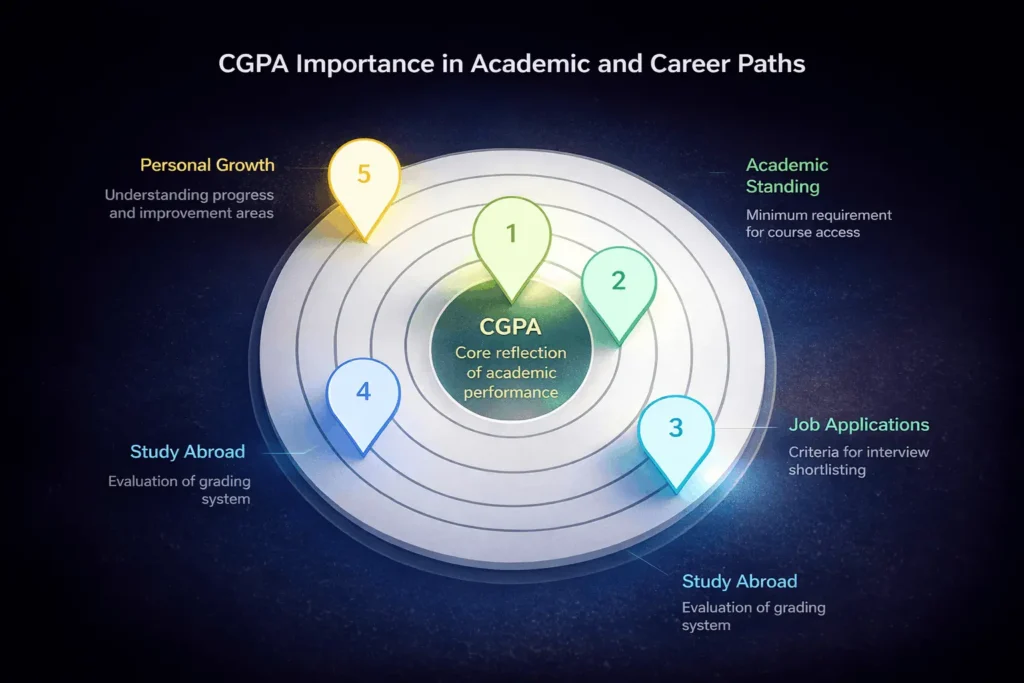
- CGPA reflects your steady work across all subjects. It shows how well you handle exams, labs, credit hours, and semester tasks. Colleges and companies use it to judge your consistency, not just one test. A strong average makes your profile stand out during admission and placement.
- Many universities set a minimum CGPA for each semester. Students must meet this mark to stay in good academic standing. Some colleges also use CGPA to decide who can take honours courses, project work, or internships.
- CGPA also matters in job applications. Recruiters look at your grade point average when they shortlist students for interviews. A steady record tells them you can manage deadlines, understand core subjects, and maintain focus under pressure.
- Study abroad applications also check CGPA. Many global universities accept transcripts in percentages, but they still look at CGPA to understand your grading system. Some colleges ask for a CGPA conversion certificate when the grading system is different from theirs. These requirements make it important to know both your CGPA and your percentage.
- A strong CGPA not only helps during admission. It also helps you understand your own progress. When you track your average across semesters, you see clear patterns. You know where to improve, and you know which subjects need more time. This awareness helps you grow as a student.
Difference between CGPA & GPA:
CGPA and GPA look similar, but they measure performance in different ways. The table below shows the key points students must know before converting marks for admission, exams, or study abroad forms.
Point of Comparison | CGPA | GPA |
Full form | Cumulative Grade Point Average | Grade Point Average |
What It Shows | Average score across all subjects | Score for one term or semester |
Time Range | Long-term performance | Short-term performance |
Use Case | Common in Indian colleges and universities | Common in the US, Canada, and many foreign colleges |
Grading Scale | Often, a 10-point or 7-point scale | Usually, a 4-point scale |
Based on | All subjects with credit hours | Subjects taken in a single term |
Scope | Wider academic view | Snapshot of performance |
Conversion | Needs a formula based on a grading scale | Often converted when compared with 10-point systems |
Used For | Admission, placement, and semester records | Course evaluation and GPA-based entry rules |
Key Points You Should Know:
FAQs:
Conclusion:
Students need a clear way to convert CGPA to percentage because every board and university uses its own grading system. This calculator brings those rules together in one place. You enter your CGPA, choose your grading scale or university, and get the exact percentage with the correct formula.
The goal is simple. Remove confusion. Save time. Give students a tool that works for school records, college forms, engineering schemes, placement rounds, and admissions. Each result follows the rule used by the board or university listed in its official guide.
With this tool, students can check their standing across semesters, track progress, and share marks with confidence. A clear conversation helps during applications, interviews, and study abroad steps. It keeps your records accurate and easy to understand.

About the Author
Mian Saqib Rasheed
Founder of GPA Converter Hub | Civil Engineering Graduate
Mian Saqib Rasheed is the founder of GPA Converter Hub and a Civil Engineering graduate. Inspired by challenges he faced while calculating GPA, CGPA, and academic percentages during university, he created this platform to help students access accurate educational calculators and resources.